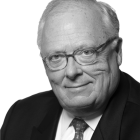
EDWIN J. FEULNER: I welcome you to this very important discussion on public diplomacy. First, a little bit of ancient history.
In the first Reagan Administration, I was invited by the President to serve as a Member, and then as the Chairman, of the U.S. Advisory Commission on Public Diplomacy. I had the honor of being a Member and the Chair on that panel for almost 10 years, under both Reagan Administrations, the Bush Administration, and well into the Clinton Administration. I had the opportunity to see public diplomacy up close and to see the incredible importance it had in terms of conveying America's message internationally and in terms of going beyond the customary notion of U.S. State Department talking to a foreign ministry or government talking to government. In effect, it was a people-to-people kind of communication.
The Nature of Public Diplomacy
Public diplomacy for me is more than one more area of study; it is
a central part, not only of our foreign and defense policy
infrastructure, but something that I've been very, very much
involved in. I also commend our colleagues at our sister
institutions, my own alma mater, the Center for Strategic and
International Studies, which is going to be holding a seminar
on a similar subject within the next few days with the new head of
Radio Free Europe/Radio Liberty from Prague, and others. Public
diplomacy, in fact, has come back center stage even as experts
admit that we have some real challenges in terms of getting caught
up again, if you will, in terms of public diplomacy.
Shortly after the American Revolution, John Adams was asked how
many supported the war and how many were opposed. Adams said about
one-third of the population had supported it, one-third had opposed
it, and about one-third was waiting to see who won. In many ways
that's the situation America faces today in the court of world
opinion. There are still those around the world who wish to work
with us, there are those who attempt to do us harm, and there are
those who are simply waiting to see which side will prevail. Today,
as has been the case throughout our history, America has a peaceful
message, yet we are doing some harm to the nation and to our
credibility by not effectively advocating for ourselves.
This manifests itself in many ways, but especially concerning the
War on Terrorism. As that distinguished group of Americans
said in the 9/11 Commission Report, "If the United States does
not act aggressively to define itself in the Islamic world, the
extremists will gladly do the job for us." Unfortunately, that
reality is part of why the opinion of America and our intentions
remains abysmal in most Muslim countries. A recent lack of
effective public diplomacy abroad continues to affect world opinion
in a negative fashion-even among many of our allies.
According to the Pew Center, only 9 percent of the Turkish people
and just 15 percent of Pakistanis have a favorable view of the
United States. Thirty percent of Germans have a positive view of
America, down from 42 percent as recently as two years ago. Our
favorable ratings continue to drop even in our allies, Great
Britain and Canada.
Studies like this have repeatedly found that U.S. government
agencies and departments are hampered in their efforts to
improve public diplomacy by a combination of poor leadership,
inadequate coordination, and insufficient resources.
Complicating the problem is the fact that we have to become
more targeted, more deliberate and coordinated than ever before
when reaching out to foreign audiences.
In short, the U.S. must develop a strategy that reflects our
current position in the world that utilizes dynamic new ways
to deliver information to individuals and to articulate the
ways we want to be perceived. What should that strategy look like?
What are our priorities? Do we need new tools to get the job done?
Have we learned from our public diplomacy successes and failures
during the Cold War? Answering these questions, while immensely
challenging, is critical to America's future. It is, however,
a challenge I'm sure our panelists today will not shy away
from.
It's now my very great pleasure to introduce our colleague, Helle
Dale, who will moderate this discussion. She is the Deputy
Director of our Kathryn and Shelby Cullom Davis Institute for
International Studies and the Director of our Douglas and Sarah
Allison Center for Foreign Policy Studies.
Edwin J. Feulner, Ph.D., is President of The Heritage Foundation.
HELLE C. DALE: Washington has come to realize that there is a problem with our public diplomacy efforts. As Dr. Feulner mentioned in his introduction, public diplomacy is an issue that The Heritage Foundation has been engaged in for several years. Speaking as a former journalist, it is also an issue that I care a great deal about, covering the way the world looks at the United States.
If there's one thing that the many, many studies on public diplomacy have taught us-going back to the studies done since September 11, 2001-it is that U.S. government agencies have been hampered in their efforts by lack of coordination and by lack of a vision and leadership from the highest levels. It's unfortunate that we have spent so much of our efforts on the high power/soft power debate while neglecting the impact that soft power, communication, and strategic thinking have on how to communicate and influence audiences abroad.
As part of the campaign on Leadership for America, which The Heritage Foundation has undertaken over the next five to 10 years, public diplomacy is a really important part of our foreign policy agenda, reinvigorating American foreign policy and its public diplomacy functions. I am very privileged to be part of that effort, and the meeting we're having today with a set of excellent speakers is a kickoff event for a yearlong effort that will look at how to assemble a public diplomacy strategy, looking forward to the next administration.
Obviously, we have to give credit where credit is due. I would say to some of our speakers here today that the efforts for the last two years of the Bush Administration at least have intensified greatly, and we have seen improvements in the public diplomacy arena. I'm delighted to be able to welcome one of the key people on Ambassador Karen Hughes' team, which has been very instrumental in formulating something closer to the kind of strategy we need, creating more interagency interaction, and rapid reaction teams to deal with news reports all over the world that are detrimental to the reputation of the United States.
Colleen Graffy assumed her duties as Deputy Assistant Secretary for Public Diplomacy in the Bureau of European and Eurasian Affairs of the State Department in September 2005. In this capacity, she oversees public diplomacy and public affairs programs for the Bureau and coordinates efforts with the Under Secretary for Public Diplomacy.
She has been very well prepared for dealing with matters European. Before her current position, she was Academic Director and Associate Professor of Law at the London Law Program for Pepperdine University. She is originally from Santa Barbara, where she earned her Bachelor of Arts at Pepperdine and her Master of Arts from Boston University. She also spent a year in Heidelberg at the university, so she clearly has a deep understanding of Europe. She resided in London for 20 years, where she was on the front line of communicating U.S. positions on international issues to a very tough audience. But we know that our audience today will be a little friendlier, and we are looking forward to your presentation.
COLLEEN GRAFFY: During a visit to Russia last year, I was asked to speak at our America Center in Moscow. There was a large crowd and I was a bit uncertain how I would be received. I launched into my background-growing up in Santa Barbara, California, my education, and so on. It soon became apparent during my remarks that I was receiving an exceedingly warm reception; everything I said seemed to be interesting and delightful, and I left quite pleased with my success.
The next day I was interviewed by a reporter from Radio Free Europe/Radio Liberty, and after a lengthy interview he hesitated and said, "Please, I must ask you one more question on behalf of our listeners. We understand you are from Santa Barbara. Is everything really as wonderful as it is in the soap opera?"
I have the feeling that just being from Santa Barbara doesn't carry quite the same cachet here as it does in Russia and Eastern Europe where the soap opera is still in reruns. However, it is a good reminder of the power of television and of the challenges we face in strategic communications today.
Many view the strategic communications of the Cold War as the solution to our public diplomacy challenges today. Unfortunately, many of the solutions that were valid then fall short now. Of course, there are similarities between the two struggles. Then, as now, we fought an implacable enemy opposed to our entire liberal value system. Then, as now, we talk about existential struggles between enemies with opposite belief systems. But there are important differences.
During the Cold War we fought an enemy that used power to exercise totalitarian control. Communism contained its people behind an iron curtain and controlled information within it. The populations in the Soviet Union and other Communist nations were either kept in the dark about what was happening outside or had imperfect information.
All we needed to do was get facts through the censors' wall. Our truths, in the words of the Founding Fathers, were "self-evident." Censorship was a tool in the battle of ideas then; breaking through it defined success.
It is hard to believe that less than 20 years ago half of Europe and about half of mankind lived behind such censors' walls. Today, only small isolated pockets like Cuba and North Korea remain.
In the new battle of ideas, there is, to be sure, censorship to be circumvented. Iran is an example that comes to mind, but Radio Farda and Voice of America TV (which reaches 1 in 5 Iranians each week) circumvent the censorship-also via the Internet-with great success.
But in most of the rest of the world, what we are doing is fighting for space in people's ears and, more importantly, their minds. We are competing against not just al-Jazeera, but the Internet, iPods, Nintendo, Wii, Xbox, Playstation, film, videos and, of course, soap operas.
And we're fighting al-Qaeda, which uses all forms of media to get its message out. As the President's nominee to replace Karen Hughes, Jim Glassman, said in his testimony, al-Qaeda "disseminates its messages through mass media and the Internet, and our job is not merely to explain and advocate American values and policies but to counter the disturbingly persuasive ideology of the enemy."
Public Diplomacy: The Co-Pilot
Today, we are actually not doing so badly. But the title of this
event, "Reinvigorating America's Public Diplomacy," is a
good reminder that most people don't know what we have already done
to invigorate public diplomacy. In addition to doing public
diplomacy, we also need to communicatewhat we are doing on
public diplomacy. We need to do more public diplomacy on our public
diplomacy!
Do people know about the media hubs in Brussels, Dubai, and London? Do they know about the TV studio that is now completed and about the first broadcast that took place last week? Do they know about the 30 percent increase in U.S. government officials on television? Or the emphasis on "getting visual"? Or the increasing number, as Edward R. Murrow described them, of "take offs" in which public diplomacy is not only on the plane, but in the co-pilot seat along with policy?
For those who are aware, I am delighted. For those who are not, I am grateful to Ed Feulner, Helle Dale, and The Heritage Foundation for inviting me to join this distinguished panel and share what we have been doing on the public diplomacy front in the Bureau of European and Eurasian Affairs.
A top priority of the Bush Administration's second term has been to elevate the role of public diplomacy and to fuse it with policy. The first step was to appoint a high-level communicator as Under Secretary-Karen Hughes-and create dual-hatted Deputy Assistant Secretaries in each geographic bureau who would report to both their Assistant Secretary on the policy side and the Under Secretary on the public diplomacy side. The importance of public diplomacy was underscored by having a full-time, front office Deputy Assistant Secretary to oversee public diplomacy throughout the entire Bureau working side by side with the policy makers.
As a law professor who had been living in London for over 15 years teaching international law at Pepperdine University, I had done a significant amount of media and understood the necessity and challenges inherent in communicating complex issues in the new media environment. I was therefore delighted to be parachuted back into America for the fused policy and public diplomacy position-and ecstatic not to have to grade any law exams.
Further integration took place when we embedded our Public Diplomacy Desk Officers into each of their geographic regions. Rather than sitting together in the public diplomacy office being on the receiving end of their region's distribution list and appearing for their staff meetings, they are now a part of the policy team doing public diplomacy right there from the take-off.
For example, our Balkans Public Diplomacy Desk Officer plays an indispensable role on Kosovo. She is working side by side with the office director and the Deputy Assistant Secretary responsible for that policy portfolio. She is able to respond on guidance taskings for the daily State Department briefings and to recommend media strategies because she has the minute-by-minute knowledge of what is happening on the policy side.
Likewise our Public Diplomacy Desk Officer for Poland and the Czech Republic was able to pick up the missile defense issues and develop interagency communications strategies, including creating an intranet Web site by which to keep everyone informed.
Strategic communications that use public diplomacy to promote our policies cannot take place when the two are estranged. It is hard to do when you are in a separate office, on a different floor; when you are in a separate office in a different building I would say it is well-nigh impossible. We can't be there on the take-off if we are at different airports.
Communicating Who We Are
It is for this reason that I am alarmed when I hear calls for the
revival of the United States Information Agency (USIA), which
was not only in a separate location from the State Department but
it had a separate e-mail and computer system! Rather than merging
policy and public diplomacy, the reporting line created confusion
between the Ambassador at post and the officer's USIA superior in
Washington. The Center for Strategic Communications Commission
on Smart Power's report recommends an "autonomous organization,"
which would be a "quasi-independent entity…responsible
for the full range of government public diplomacy initiatives,
including those formerly conducted by USIA." This too would pull
public diplomacy away from the power base of U.S. foreign
policy and diminish its influence.
Although the merger pains of USIA and State are still apparent, it is healing and we are headed in the right direction. These well-intentioned recommendations pull us in exactly the wrong direction.
Public diplomacy is the art of communicating a country's policies, values, and culture to other peoples. It is an attempt to explain why we have decided on certain measures and, beyond that, to explain who we are.
There are two sides to this public diplomacy coin: One is short-term, the immediate, 24/7 media side where we engage through TV, Internet, and radio. The other is long-term relationship-building where we engage through cultural diplomacy, sports diplomacy, student exchanges, and Muslim engagement.
We have invigoratedourpublic diplomacy by fusing policy and public diplomacy and creating new tools by which to effectively operate in these two short-term/long-term frameworks. Our new tools include:
- Getting outside of the Washington bubble by listening to the conversation in Europe via the EUR Early Alert, a compilation from 11 posts of the key headlines and issues, received by the opening of business in Washington each day;
- The Rapid Response Unit, which follows the top two or three global issues with policy responses each day;
- A streamlined clearance process to allow Ambassadors and Embassy staff to respond immediately to domestic media requests-changing the default position favoring off-the-record print roundtables to more on-the-record print, television, and new media;
- The creation of a Media Hub in Brussels to get us inside the media cycle and to facilitate pan-European communications (For example, we will take advantage of an official visiting Spain for discussions on Cuba by also doing interviews on that topic for media in London, Prague, Budapest, or Warsaw. We also have hubs in Dubai and London.);
- A new TV studio that is allowing us to have targeted messaging for specific distribution;
- A new European Media Liaison position to work with the hubs in identifying interagency voices in Washington for interviews and working interagency on principals who will be going abroad to get media on their schedule;
- A new "pre-active" approach to media that anticipates and helps shape stories;
- A new TV and Video Adviser Position that is helping to transition our posts and Web sites to using film, video, and trainers in Europe to help train individual posts and regions; and
- A new Senior Adviser on Muslim Engagement, whose task is to concentrate on the issues surrounding integration, assimilation, democracy, and Islam. Farah Pandith reaches out to Muslim communities in Europe full time to talk about America and our respect for all faiths.
In case you want to see more of this, we now have on our Web site with the user-friendly http:// europe.state.gov, our own little button-"Newsletter Public Diplomacy in Europe," which will link you to our public diplomacy monthly. We don't know how long it will take, but we hope someday for the end of anti-Americanism.
HELLE DALE: Our next speaker will be Dr. Michael Doran. He was appointed Deputy Assistant Secretary of Defense for support to public diplomacy in April 2007. He is responsible for advising the Department's senior leadership on policy to support public diplomacy and strategic communication and for advocating key themes and messages to promote U.S. national security interests.
Prior to joining the Department of Defense (DOD), Dr. Doran served as Senior Director for Near East and North African Affairs at the National Security Council. His portfolio covered all of the countries in the region except for Iraq. Before that appointment, he was Professor of the Department of Near Eastern Studies at Princeton University, and from 2002 to 2004 he served as an Adjunct Senior Fellow at the Council on Foreign Relations in New York.
Following September 11, Michael Doran conducted extensive research on terrorist uses of the Internet. This research informed an influential article he authored on Osama bin Laden titled "Somebody Else's Civil War," which was published in Foreign Affairs magazine in 2002. It also informed an article on Saudi Arabia titled "The Saudi Paradox" the year after. He has written in numerous other publications on the depth of the Sunni-Shiite conflict in the Middle East. Originally from Indiana, Dr. Doran received a Bachelor of Arts from Stanford in 1987 and a Ph.D. from Princeton in 1997.
Then we will hear from Dr. Joseph Duffey. He joined what was then Sylvan Learning Systems as Senior Vice President in 1999, and he helped shape the company's plans to build a worldwide network of universities. It is now known as Laureate, and he is responsible for education and academic quality for the network.
He was Director of the U.S. Information Agency, a position he was appointed to by President Bill Clinton in 1993. Before that, he was President of American University here in Washington, and previous to that he was Chancellor to the University of Massachusetts in Amherst. He has been Assistant Secretary of State for Educational and Cultural Affairs and Chairman of the National Endowment for the Humanities under Presidents Jimmy Carter and Ronald Reagan. He also served on the faculty at Yale University, as a Fellow at the JFK School of Government at Harvard University, and as a delegate to the General Conferences of the United Nations Educational, Scientific and Cultural Organization, also known as UNESCO.
Our last speaker today, Tony Blankley, is currently working with The Heritage Foundation on reinvigorating public diplomacy and strategic communications. He is an Executive Vice President with Edelman Public Relations here in Washington and a Visiting Senior Fellow in National Security Communications with The Heritage Foundation.
You know him well from the media, where he is found in many, many different forums. He hosts his own program, Left, Right and Center; he is the author of a best-selling book on the struggle with Islam called The West's Last Chance: Will We Win the Clash of Civilizations? He appears on CNN, CNBC, and of course, with The McLaughlin Group. Tony Blankley was the Editorial Page Editor for The Washington Times for the past five years, and he is a Contributing Editor and monthly columnist for George magazine. He still writes a weekly column for The Washington Times. Before that, he had a long, distinguished career on the Hill. Many of you will remember Tony as Press Secretary to Newt Gingrich for seven very interesting and stormy years in the 1990s.
Now I will turn over the program to Michael Doran to tell us where the efforts of the Defense Department are leading currently.
MICHAEL DORAN: Let me just start by saying a few words about my office. I think that instead of laying out a plan for the future of public diplomacy, I'll sort of discuss with you my experiences over the last eight months in this realm; the difficulties I see, the challenges before us, and some directions that I think we need to move in. Then I'll let you guys put together the big plan about how to solve these problems.
The office that I had was established over a year ago, and I came onboard about eight or nine months ago. It represents a growing awareness in the Department of Defense that we have a public diplomacy role to play; it represents an awareness that you can't conceive of military operations in isolation from other forms of national power, and, as Colleen said, that you have to take into consideration the public diplomacy aspects of any operation at the takeoff, from the beginning. It isn't something that you can do afterward. I think that that realization has been around in the Department of Defense forever. I think there was an increasing awareness of it at the time of Bosnia and the Clinton Administration, and it's only increased with the Iraq War.
The difficulty in the Department of Defense is that you can get everyone to get it, but how do you change the institutions and the procedures so that the realization that people have is translated into organization and policy? That's an extremely difficult thing to do.
One of the things that I've said to my staff is that we are a small policy office, we're a startup, we can't possibly own anything. We can't own public diplomacy, we can't own strategic communication. What we can do is be kind of a transmission belt; a transmission belt within the Department of Defense and a transmission belt between the Department of Defense and other departments. We can create communities of interest, set agendas, and put our voice into the policy debate.
The Mission
That's the mission we have. The mission is to make public
diplomacy and strategic communication part of DOD processes
from the takeoff. We also have primary responsibility in the
Department for combating ideological support for terrorism, so the
ideological struggle against al-Qaeda is pretty much at the center
of what we do. From there, and with an emphasis on this ideological
struggle against al-Qaeda, let me just say a few words about the
challenges before us.
If you look at the successes that we've had in Iraq over the last eight to ten months with the surge, one thing I think becomes glaringly obvious: that the success there wasn't really a success of arms; it was a success of enlightened understanding of the challenge in Iraq. And it was General David Petraeus's understanding that this is a counter-insurgency operation and that the first goal is to provide security to the population. This is a people-centric war, a perception-centric war, and it was a contest with al-Qaeda over the population. It was in part an information contest, but first and foremost it began with security-providing security and then allowing those people within Iraqi society to step forward to fight al-Qaeda themselves. That's where our greatest success has been, in empowering others to fight al-Qaeda.
The Four Pillars
I think that there's a lesson to be learned there about the nature
of the conflict we're in and the tools that we need in order to
fight it. It seems to me that if you break down the contest with
al-Qaeda into areas of operation, or pillars of operation, there
are four major pillars. One is to improve our brand, and that is, I
think, the primary goal. Organizationally, that's the
responsibility of the State Department's public diplomacy.
That is, we need to counter al-Qaeda's claims that we are at war
with Islam, and we need to project the best side of the United
States to a global audience.
The second thing we need to do is to attack al-Qaeda's brand. We need to make the world public aware of the intimidation of al-Qaeda, the intolerance, and also I think we should attack their brand by sowing fissures within the organization itself. That's a job that runs across the spectrum of the United States government, from the CIA all the way over through Department of Defense all the way over to the State Department.
The next two I think are the most problematic. We need to empower moderates. So we have the attack pillar, the burnish American image pillar, and then the empowerment of third parties pillar.
The fourth pillar is the informational pillar. We need to know; we need to have information about what is going on out there in the world that informs our policies and our statements and that gets back to the center. Those last two are the most problematic because it isn't about getting our message out in this "empowering third parties" pillar, it's about helping others to get their message out. Ultimately, if this is a contest-as I think General Petraeus has shown us-between Arabs, between Muslims for the future of their society, it's the empowering part that's the most important. And sometimes our direct hand doesn't need to be seen.
I'm not talking about covert or clandestine, but we don't need to be out in front. Let me give you an example. Suppose you're an Iraqi movie producer and you want to do a documentary on the rejection of the tribes of al-Qaeda by the tribes of al-Anbar. Or even better, suppose you are a European moviemaker and you want to do that and you want to present it to a European audience. Who do you go to in the U.S. government to get a grant to do that? This is not covert, this is not clandestine. You're quite willing to say in an overtly attributable manner that you took money from this or that department. Who do you go to and whose responsibility is it to see that that kind of thing happens?
Information Distribution
Suppose that we sitting in Washington notice something like the
tribes of al-Anbar rejecting the tribes of al-Qaeda and we say,
"You know what? That rejection is an important message that needs
to be gotten out to Europeans. It needs to be gotten out to people
in Afghanistan and elsewhere."
As a Defense Department activity, we can't say that we're going to empower these people to put out this message to the Europeans. I think there's more likelihood that's going to be a Department of State activity, but State isn't resourced properly to do that. Also, State is not organized to look at what's going on in Iraq and say, "We need to put this out in Europe."
Maybe resurrecting USIA is not a particularly good idea. But there does need to be some agency that is resourced and has the authority to engage in this kind of informational struggle, taking very much in mind what Colleen said about making sure that it is part of the takeoff-that it is deeply embedded with policy thinking at the highest levels.
One of the biggest tasks that you could take on here at Heritage is meeting the challenge that Colleen put to you about how to make sure that this information strategy is embedded in policy thinking-an information strategy that takes into account the distributed nature of the media in the world today, the need to empower third parties, and the need to put out information through a variety of different channels other than just formal public diplomacy mechanisms. I don't have the answer to that, but I do feel daily the difficulty.
The 26-Minute Problem
Let me add one more aspect to the difficulty. That is the
decentralized nature of our system. We have tried to be more
responsive to the demands of the information environment. What do I
mean by the demands of the information environment? We carry out an
operation in Afghanistan, and within 26 minutes-we've timed it-the
Taliban comes out with its version of what took place in the
operation, which immediately finds its way on the tickers in the
BBC at the bottom of the screen. That then leads to questions about
what happened in this operation, and we don't know the answer
to this. This requires us to get the actual answers to the people
who are truthful, complete answers to the people who are speaking
to the press.
This can take an investigation of weeks, and by that time we're not even really talking about news cycle anymore, because in 26 minutes it's already out there. You can't correct three weeks or two weeks later something that has already come out in 26 minutes. So in trying to deal with this, what we have tended to do is push authorities down as much as possible-to decentralize, to give people on the ground the tools and the authorities that they need in order to meet the needs that they are experiencing on the ground. That's been effective within certain limits. The State Department (I think) is also working in these lines, building the media hubs, encouraging officials to get out and to speak, and making speaking in the media part of one's job performance appraisal.
All of that is very good, but there is still in government the natural tendency to want to control things from the center, and for good reason. If somebody messages something wrong out in the field, it isn't the guy in the field who's called over to Congress to testify about it. It's the people up at the top-messaging very quickly ties to policy-and can very quickly become a problem for somebody back at the center. It's almost impossible to solve that problem.
Then, as we have pushed things out to the field, we don't have back here-and this is my main point-any kind of strategic center that is aware of what's going on in the field and is resourced to deal with it. So if I notice back here in my office that there are tribes in al-Anbar rejecting al-Qaeda and I think it would be good to get that message out in Europe, I don't have any way to do it. Again, what we do in my office is build coalitions, be a transmission belt. So I can start bringing people together and say, "Hey, we should really do this," but that is highly cumbersome and not always particularly effective.
The Nature of Media
There needs to be, I think, some deep thinking about the nature of
the media environment, the need for some kind of centralized
control, but also the need for decentralization.
With regard to the centralization, the answer that you always hear is an office in the NSC, and when people talk about how things work correctly, they look at the Eisenhower Administration or the Reagan Administration. They say, "Yeah, there was an empowered person at the NSC that did this." I'm not sure that this is the right answer, and as you think through this, I would just be aware of the kind of antibodies in our system to that.
Number one, the NSC is by design non-operational. So this is one of those areas in the Department of Defense and the Office of the Secretary of Defense-Policy in which the policy office is non-operational and the NSC is non-operational. If you resource it and you put somebody in power- somebody at the NSC-you are making them operational. Even if somebody thinks for a minute that this is a good idea and they set it up, there are very quickly going to be antibodies that are going to work against it.
The strongest antibody is going to be the fact that a mistake is going to run like an electric jolt from the field up to the President and tarnish the President, whoever he or she is. So there's going to be a tendency in the system, again, to push it out to the agencies who are usually resourced to do this.
It's that kind of thinking, I believe, that is leading the Secretary of Defense to say that we need an agency that is resourced and has the authorities for this kind of thing. If there is such an agency that's built, I think that in today's media environment there's got to be a strong public-private partnership component to it. A lot of the kind of messaging that we're talking about is best done, if not directly by the United States, by third parties that have more latitude than we do, but yet are connected to the U.S. government. Again, the challenge there is to make sure that these third partiers are working within the strategic framework of the government.
Those are the challenges. There's a book that came out after Vietnam called Bureaucracy Does Its Thing. I was discussing with one of my colleagues the difficulties that we face in this realm, and he put that on my desk. It makes chilling reading because you see that there were many people during the Vietnam War who got it, who understood what it was that we were doing wrong. But the institutions were not set up to meet the challenges of the day, and the bureaucracies continued to do what they were tasked and resourced to do.
In this realm, it seems to me that we're facing a similar circumstance. It's very easy to look at the people who are doing this job and say, "They just don't get it." I think they do get it; the challenge is really one of organization and process, and it is extremely, extremely difficult to meet.
Simply another agency or another report is not going to do it. We have to think in a new way.
JOSEPH DUFFEY: I simply wanted to look at this a little bit in terms of history. I'm reading now The Mighty Wurlitzer by Hugh Wilford. He chronicles the covert operations of the CIA very carefully over the course of a half-century. I actually discovered that I was working for the CIA on more occasions than I thought. When I was 30 years old, as a scholar who had read the early manuscripts of Karl Marx-the 1844 manuscripts that were not published during his lifetime and really dealt with the question of consciousness in society-I became interested and established some very brief relationships. Life was difficult for them, some of the dissidents in Eastern Europe, particularly Lesa Kolikowski in Poland and Lukacs in Hungary.
Public Diplomacy Experience
When I was 30 years old I had two children, not much income, and
was teaching at a theological seminary. I wanted to go to Eastern
Europe for the summer. There was a program at the Christian
Conference at Charles University. Strangely, just by
mentioning it to a local newspaper editor, I received one week
later a $700 grant from an obscure foundation in New York.
Later, when I was at Yale University on the faculty, Kingman Brewster called me in, closed the door, and told me that he and McGeorge Bundy had decided that I should go to Paris to try to reinvent the Congress for Cultural Freedom-an effort that never quite worked out for a lot of different reasons. So I had experience during that particular period with public diplomacy as well.
I had worked for the Jimmy Carter campaign and opposed one position he was taking rather strongly, which was to create a national Department of Education. He'd made a promise, and he took his promises seriously. When he called me in for a job just shortly after the inauguration, he said, "This will not be a permanent appointment; I want only you to know that right now, but I have committed myself to moving the Bureau of Education and Cultural Affairs at the State Department into USIA."
The reason was that in the summer of 1976, the Israelis had attacked a boat in the Mediterranean with some Lebanese leaders on it, and it had been reported by the Voice of America. Immediately they were called in by the State Department and by Mr. [Henry] Kissinger. Then Frank Stanton (then of CBS), who created the Stanton Commission, said "Let's get them out of the State Department where they are totally free to be independent journalists."
I began, with the help and understanding of my colleagues at the State Department. I believe, by the way, that Karen Hughes is on her way to a functioning unit of men and women whose assignments come on the basis of building an understanding of cultural areas, which is not what happens in the regular assignments of the Foreign Service Office. I believe that Karen has absolutely done the right thing. What she has done is allow us to watch her learn, and, in a modesty that I very much admire, she will admit that she has gone through the process of listening and learning.
I was there for awhile but we had to leave. I started writing memos, however, every week to the White House saying, "What USIA does is not public diplomacy. Public diplomacy is this effort at a two-way conversation. That's not the culture of USIA." I never saw those memos or knew that they had that much impact. A new book about to be published by a historian in Britain states that they made Jimmy Carter actually try to change USIA by creating something called the International Communications Agency (ICA). It didn't last long. ICA didn't quite work. Mr. Reagan, maybe for the right reasons, abolished it immediately.
Post-Cold War Diplomacy
Bill Clinton becomes President. I go to USIA with the feeling that
the Cold War is over, and that is posing a real crisis for the
United States. The issue we have with public diplomacy and our
presentation to the world is not an issue that comes out of 9/11,
although it is an issue that was very evident then.
Nations are at their most volatile, and maybe most dangerous, when they are humiliated, and we were humiliated by Vietnam and the Iranian hostage crisis. What were we celebrating? That's what I sensed when I got there in 1991. At my swearing in, I had a dialogue with men and women to talk about stopping, listening, and then talking about how we want to present ourselves to the rest of the world.
But the atmosphere I encountered was one of euphoria. The Cold War since may have ended, in fact, with coexistence. What we were celebrating was the collapse of the Russian economy. I'm not sure that had a lot to do with public diplomacy; I think it had to do with President Reagan's very wise policies, with his defense and armaments policies, but it was an era of great celebration and triumphalism. That was really what led to the abolition of USIA.
The idea of moving the USIA to the State Department was former Secretary of State Madeleine Albright's idea. The central reason was money, because she was under enormous pressure because the budgets had not been increased. I remember State Department colleagues, who I love and admire-but who sometimes I think are working in a dysfunctional institution that we need to work on-saying to me, "Why are you cutting, not increasing, our budget? We won the Cold War; don't you know that?" And I think Madeleine Albright did it out of a sense that American media and American culture had triumphed in the world.
Listening Tours
So when I went to USIA I tried to get my colleagues to stop
and learn more about America. I was and still am a regular reader
of The Washington Times, and some of my colleagues may
remember that I used to take it into the staff meetings. Nobody
else ever read it. One reason I took it was because of that second
page on culture, which I thought was so important in describing the
growth of home schooling and of all the other things
happening, and I don't think my colleagues with whom I worked, for
understandable reasons, really understood what was happening in
America.
I tried to get us to understand that the world did not really admire us, they envied us, and that is a different kind of impulse. So I switched as much as I could from polling to focus groups to try to get us to understand that the image was not quite what it was. I took a lot of cues from Prince Charles, who in the early 1990s talked about the gulf between Islam and the West. That is still very much there; it's the fodder for this problem we're confronting. I got in great trouble with a The Wall Street Journal editorial for saying we should listen for awhile. The Cold War was over, but I loved the fact that Karen Hughes went on listening tours.
Let me just say that as we leave here today, there is another meeting across town on the publication of a new book, which is the largest polling of Muslims around the world that is being conducted. Actually, it's gone on for six years; they're talking about 50,000 interviews, and not just in the United States. This is the summary: Large majorities of Muslims around the world would guarantee free speech (if it were up to them) and write a new constitution, and they say religious leaders should have no direct role in drafting that constitution.
Muslims around the world say that what they least admire about the West is its perceived moral decay and breakdown of traditional values, and some answer that Americans themselves often give that same answer to the question. When asked about their dreams for the future, Muslims say they want better jobs and security, not conflict and violence. Muslims say the most important thing Westerners can do to improve relations with their societies is to change their negative views toward Muslims and respect Islam.
I think that points more to the challenge we have-aside from
this serious military problem of terrorism, which has now a Muslim
base but has had other bases in the past. I think it's a greater
awareness of this that is the key to what we are struggling with in
a new era. I will say again, although I think we're now more ready
to do it; rethinking how we want to present ourselves to the rest
of the world, explaining America.
Madeleine Albright made this decision. She made it on the basis of
money but also she thought it was all over culturally. I can
remember how angry she was when I was taken to task by the Motion
Picture Association for saying that I thought one of the great
sources of disinformation about America was Hollywood. It's
our best and our worst representation.
Tony Blankley: When I wrote my little book back in 2005, I predicted that a prominent Western public figure would call for Sharia law to be respected. A number of reviews harshly criticized me for being ridiculous. If we were being effective in communicating our thoughts to the world, even an Archbishop of Canterbury might not be so obtuse as to think that Sharia law is what was called for in Britain. I can say that because I'm a former Englishman and a former Anglican, so I'm not being rude to people outside my little tribe- although Archbishops of Canterbury have a long history of being daft, I concede.
Metrics
A couple of metrics: Hamas and other similarly minded
organizations produce and distribute cartoons with cute little
mice and bunny rabbits that teach young Arab men and women, boys
and girls, to kill Jews, Christians, and Americans who are out to
wipe out Islam. That's one metric.
Another metric: We currently have an insufficient number of young American men and women 18 years and older volunteering to join the Armed Services. Every year we have to lower the mental, moral, and physical standards, we have to pay more in recruitment fees, more in retention fees, to try to maintain a relatively puny-sized military today. That's another metric.
Metric three: The European public opinion will not support NATO keeping their troops in Afghanistan to win the struggle in the heart of the land from whence came the attacks of 9/11. This is the world we live in.
I don't have the benefit of having been either a bureaucrat or a scholar. I've just been a political operative. Before that I was a prosecuting attorney in Los Angeles for eight years. In both those lines of work, we have a wonderful metric to see whether we've persuaded people. When you're a prosecutor, if the criminal goes free, you've failed to persuade. In politics, on the first Tuesday after the first Monday, if your candidate loses, you failed to persuade.
Communication Efforts
I would rather see our world communication efforts being run by
people like James Carville and Karl Rove and whoever is the brain
behind Barack Obama's current campaign than the current method by
which we try to communicate. I'm struck by the fact that our world
today, our political culture today, and political correctness
generally, don't even permit us to describe a possible system that
might succeed in protecting us by communicating effectively-not
only around the world, which is part of what public diplomacy is
about, but back home.
We had methods like this during World War II. As you know, President Roosevelt and his people ran very effective filmmaking units that in fact did persuade and rally Americans to the cause. There was a wonderful film made of Wake Island that was shown to Roosevelt and his wife in the White House, which was meant just for the troops. It was so moving that afterwards Roosevelt said, "This should be seen in every theater in America," and it was. Now, I don't know whether that was considered undemocratic during FDR's America, but I would live by the standards of democracy that FDR was able to bring to bear when we were fighting a great world danger.
I don't have the answers at all, but we've got to be honest enough with ourselves to recognize the kind of danger we're facing and figure out how we marshal resources, rather than feel so constrained by current mentalities that all we can do, in the best of intentions, is shift one little category of our bureaucracy from point A to point B on the chart. That's not going to solve the problem.
We can't even talk about the problem. I look forward to the day where we have persuaded the public enough that we have troops, young men and women, rallying to come to help. Because I don't believe American young people are less patriotic than their fathers or grandfathers-I believe that they have not heard the case, they don't understand the danger, and as a result, we have failed to communicate to our own people.
Public diplomacy is a big piece, a big central part of any way in which America communicates. But my little piece of it partially coincides and partially goes into another zone. The last several years I was wondering, "Where is it that we are designing and implementing our world communication strategy? Where is the war room for America in the war that we've had inflicted upon us by radical Islam?"
I don't think there is an effective war room the way there is an effective war room in a well-run presidential campaign. And there needs to be, and it needs to have the resources to be able to act. I agree completely that you need both a strategic capacity and a decentralized action. That's what a good presidential campaign is about. You've got a strategic plan, but you've got plenty of assets out there moving to the sound of the debate. You don't have to get approval back at headquarters if you're running a good presidential campaign. If you're running a bad presidential campaign, you do need to get approval.
Communications and Strategy
The combination of a strategic concept and of strategic resources
driving a communications effort with radical decentralization of
the operation at a tactical level is the kind of communication we
need to be doing around the world and in the United
States. I will leave it at that. I have a sense of urgency,
and I know that a lot of people in this room have talked with, on a
continuing basis, people who are in intelligence services and the
anti-terrorism effort, and they all say it's not a question of if,
but when, and we are going to lose cities to terrible events. We
should not think about merely slowly changing our bureaucracy, but
think much more radically about how we can start protecting
ourselves and communicating effectively.
We come from the land of Madison Avenue and Hollywood. The Secretary from the State Department was so apt when she talked about the Santa Barbara example. I was going to use another example, but she chose a wonderful one.
I was told a few years ago by one of our intelligence people that Dallas was a higher-ranked terrorist threat than Houston, although objectively Houston has more infrastructure, resources, energy, and stuff. The reason was because Dallas the TV show was seen throughout the world. And so they may be mad bombers, but they watch Hollywood TV. They thought Dallas was an important place, just as they thought Santa Barbara was a magical place.
The truth is that we have the greatest advertising capacity in the world and the greatest image-making capacity in Hollywood and yet we have not persuaded our population sufficiently to have those wonderful capacities motivated, as they were during World War II, to communicate on behalf of the country.
Questions and Answers
HARVEY FELDMAN: I was a Foreign Service Officer, and I was one of the very few Foreign Service Officers on loan to USIA for a considerable period of time during the Vietnam War. I was then the Cultural Affairs Officer in Hong Kong when I started an entirely new program. It was translations into Chinese. I knew that one day I'd end up in China, and we were going to need books. I started translating National Book Award winners-fiction, biography, history-into Chinese.
This brings me to the problem I have with this panel. I've written many interesting things, but it's all top-down. It's people in Washington are going to control the message and how it's done. I submit that you need good people in localities to know what's necessary in their localities and to get it done. I got the translators, I founded a publishing company, and we were in business. By the way, speaking of metrics, I'm also the author of the single largest-selling book that USIA ever did. It was an anti-Chinese comic book that sold 7 million copies. Again, this is not top-down, this is bottom-up.
COLLEEN GRAFFY: I think you are absolutely correct, and that is why these Public Diplomacy Desk Officers that I mentioned are in Washington working side by side on the policy. They're responsible for the regions. They are in daily contact with the post, so they are pulling from the field.
Our mantra is, "How do we bring value to the field?" And so they are acting in between both. As an example, I was just on the phone yesterday with our embassy in Ankara. They want a dance group to be brought down to Konya. They want our help to get a film production crew to capture it. Can we get it in in-flight magazines? We're working together to figure out how we can help the post to get the best of what they need to do, bring over the dance troupe, etc.
The translation program is absolutely fantastic and it still goes on, apparently thanks to you. When I was in Sofia in Bulgaria, I went around the open book market where they have all these books on Paris Hilton, trashy books on nothing about America, except for Thomas Friedman's The Earth is Flat, and other books that would not be out there except that we paid the difference between making it worth the publisher's time to publish them and to translate.
Unfortunately, finances are limited and it would be wonderful if non-governmental ogranization communities wanted to adopt regions and key books and get them translated and have the publishers do it. It would be a marvelous public-private partnership.
TONY BLANKLEY: One of our problems is that, as everybody knows, we have very few Arabic translating capabilities. I find it shocking that here we are, six years after 9/11, and we've had no serious effort to dramatically increase our capacity to translate. There are 1.4 billion Muslims in the world, and most of them speak Arabic. I understand there are questions of reliability, etc. Our government agencies have been ramping up their traditional methods of getting translators. So we have 20 percent or 30 percent more-whatever the numbers are-when what we need are thousands and thousands of people with that capability.
If FDR had been given the challenge, he would have figured out how to have recruited from around the world people to help us translate so we can monitor the Internet. We can intervene on the internet around the world, locally. Instead, we've done nothing other than measure success by slight increments from a level of Arabic translating capacity that is ludicrously insufficient, whether it's the FBI, State, or CIA, because we use the current methods. We haven't thought creatively enough about those problems. Until we have that capacity, it's going to be very hard, whether done from Washington or done around the world, to be able to intervene, persuade, and argue.
COLLEEN GRAFFY: I can only speak for the State Department, but there is a strategic language program, a convening of university presidents to encourage it both on the private side, and also in the government.
MICHAEL DORAN: I'm in complete agreement that you need to empower people at the local level to do this. There does, however, also need to be a strategic center looking at these things, helping to resource the people in the field, and looking at things from a global point of view. Because we have a global ideological struggle, and we have other strategic public diplomacy threats coming from competitors and other agents out there that require a unit at the center running the campaign.
Second, I tried to put emphasis on the issue of surrogates, of empowering others get out other messages that have a strategic effect we want to see. That's basically the idea behind surrogate broadcasting. Even if an agency that is resourced and given the authorities to carry out broadcasting is brought into existence, it's going to take years.
In the short term, something that we can do is drastically increase the budget of Radio Free Europe/Radio Liberty (RFE/RL). RFE/RL has a budget of about $80 million, and if you look at the Russian language or comparable foreign language broadcasts of Russian, these are resourced at $220 million or even higher. The same goes for al-Jazeera.
We're not even really competing in that respect. Something like doubling the budget of RFE/RL would be something very smart to do in the short term. That is not the official position of the DOD, that's just one man's opinion.
CHRIS ARCOS: I left Homeland Security last year. I was the first Assistant Secretary for International Affairs, and I spent 26 years in the Foreign Service at USIA and the State Department. I'm very encouraged by much of what was said, but at the same time, I'm somewhat despairing. We're trying to have a public diplomacy discussion in this country, particularly in Washington. We do not have any collective sense of how to go about this.
Let me give you an example of what I had to deal with. I had virtually every Islamic ambassador come to me and tell me how his people were treated when they arrived in the United States when they applied for a visa, how they were treated by the Committee on Foreign Investment in the United States (CFIUS), and how they were treated by Customs and Border Protection. State wasn't talking to the other agencies, and the other agencies weren't talking. We have no interagency public diplomacy effort. There's been enormous damage done because of this lack of talking to each other, and I would only say to you, Tony, that we can't do what Franklin Roosevelt did until we decide one day to declare war officially and mobilize the American people. If we try to do it on the cheap, as we did with Korea, Vietnam, and now this one...
TONY BLANKLEY: I actually recommended that in my book, a formal declaration, for precisely that reason.
CHRIS ARCOS: Because that's the only way you can mobilize the American people.
TONY BLANKLEY: Regarding recruiting trips: Persuading the country includes the President of the United States. He hasn't yet, in all these years, ever given a speech to encourage young men and women to join the Armed Forces. He's made a few throwaway lines in other remarks. Unbelievable, in my mind. Yes, the Marines, the Army, the Navy are out recruiting, and I know some of the men and women who are doing it; they're working very hard. But beyond the Services themselves, there's been no public expression of encouragement for our young men and women to join. So it's not surprising that they're not there.
MARK HUGELINI: I work at the State Department, and I'm also a graduate student in Comparative Public Policy. What I'm hearing a lot of is about creating this new agency. I have several concerns about this. We're already in the trillions of dollars for our budget. How much would creating a new agency cost us when you take into account the fact that we already have the State Department that has structures in place? We have existing structures that need more funding.
I'm also wondering about a disconnect that would take place if we had an independent agency. Right now, as Colleen was saying, we have embedded public diplomacy officers with our desk officers so they know what's going on right away; there's no disconnect. How could a new agency overcome these obstacles?
COLLEEN GRAFFY: Very quickly. About domestic outreach, I think you make a very good point, and it's not quite what you were describing, but we do have a domestic outreach team within our EUR Bureau. We select individuals to be hometown diplomats. They can come back to their home towns to speak at university schools. We also have an outreach with anyone at the State Department in our Bureau on academic community groups. I was speaking at Thunderbird and Arizona State and the World Affairs Council. That's the sort of outreach that's taking place. We need to be doing more of it, but it does exist.
How can I disagree with having more resources? I can't, but you should know that we did get a big boost in the public diplomacy budget, and also a boost in Foreign Service Officers that will include people specifically to do more public diplomacy. So that's hopeful.
And with interagency, it's hard enough to get the different bureaus within the State Department to recognize how to work together. So for example, we'll have the Western Hemisphere Bureau wondering why we're looking at Cuba, not realizing that Cuba is an issue for Eur